
Reflective Orchard Ground Cover
AgriSun supplies commercial-grade reflective ground cover engineered for practical application across commercial orchards and vineyards
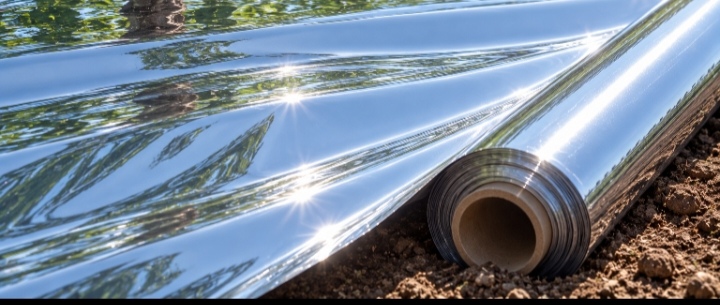
METALLISED PE ORCHARD REFLECTIVE FILM
What Is Reflective Orchard Ground Cover?
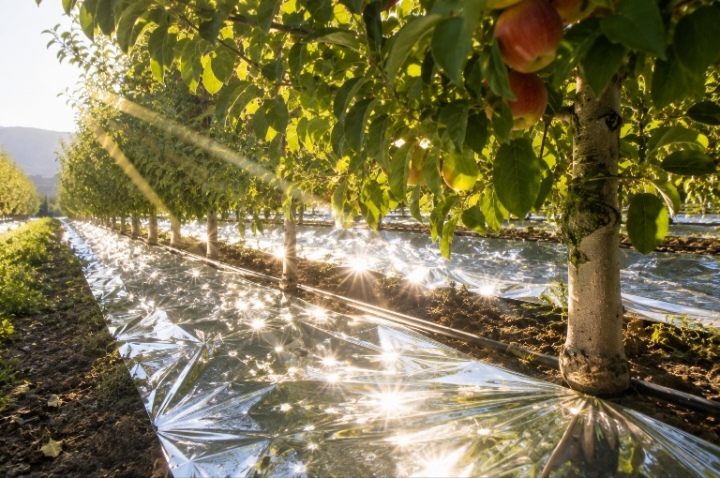
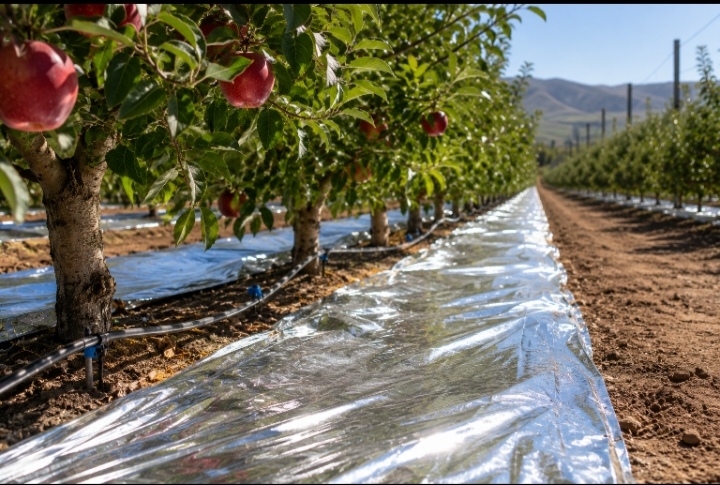
Reflective orchard ground cover is a specialised agricultural film installed on the orchard floor during the pre-harvest period. Its highly reflective surface redirects available sunlight upward into the canopy, increasing light exposure around lower, interior and otherwise shaded fruit. Unlike permanent orchard infrastructure, the film is deployed when additional canopy light is most valuable and removed after its period of use.
How it works
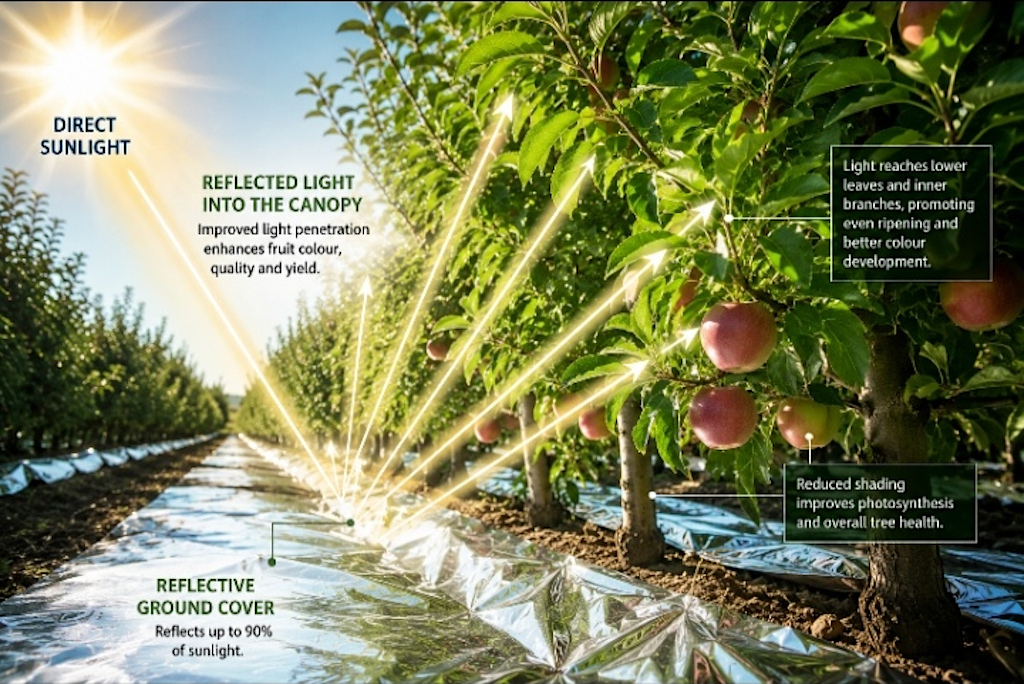
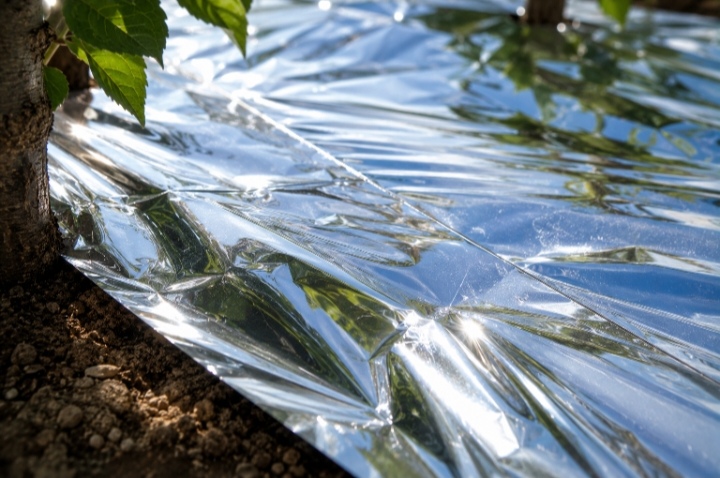
Reflective orchard ground cover works by redirecting natural sunlight into areas of the tree canopy that receive less direct light.
01 — SUNLIGHT REACHES THE ORCHARD FLOOR
Not all sunlight entering an orchard is intercepted by the canopy. A portion passes through openings between leaves, branches and rows and reaches the ground below. That sunlight represents available light within the orchard system — and it is the starting point for reflective ground-cover technology.
02 — THE REFLECTIVE SURFACE CAPTURES AVAILABLE LIGHT
Instead of being absorbed by the orchard floor, sunlight reaching the metallised PE surface is reflected back into the orchard environment. The highly reflective surface allows light that would otherwise be lost at ground level to remain available within the production system.
04 — THE LIGHT ENVIRONMENT CHANGES
With reflected light now entering the canopy from below, the distribution of light around developing fruit changes during the pre-harvest period. This is the point where reflection becomes orchard management: available sunlight is being used differently, without changing the natural light source itself.
Step 4 – Improved Light Distribution
By improving the distribution of natural sunlight within the canopy, reflective orchard ground cover may contribute to:
More even fruit colour development
More uniform fruit ripening
Improved light exposure throughout the tree canopy
Better visibility during harvesting
MORE LIGHT INTO THE CANOPY
MORE LIGHT INTO THE CANOPY Reflective ground cover redirects sunlight that would otherwise reach the orchard floor back upward into the tree canopy, increasing light availability in lower and shaded canopy zones.
SUPPORT FRUIT COLOUR DEVELOPMENT
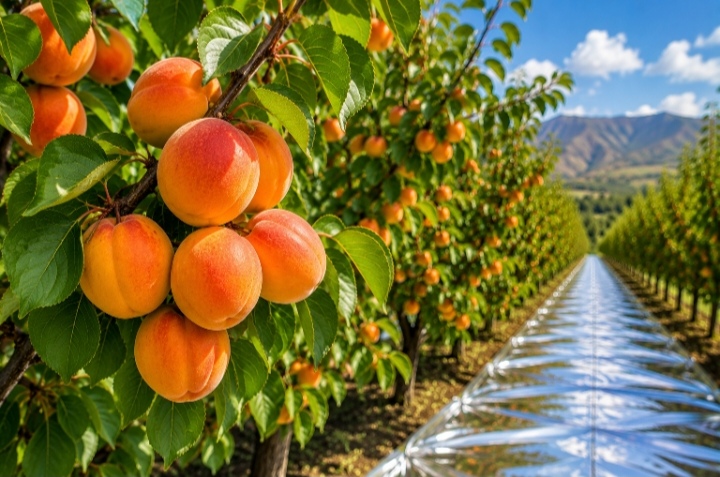
Light is a major environmental driver of colour development in many red and blush fruit cultivars. Increasing light exposure around shaded fruit can support anthocyanin development and improve colour expression during maturation.
IMPROVE COLOUR DISTRIBUTION
By introducing light from below, reflective ground cover can reach fruit and leaves that direct overhead sunlight may not. Research has reported improved colour coverage and more uniform colour development in a range of fruit crops.
All Products
METALLISED PE REFLECTIVE ORCHARD GROUND COVER
AgriSun supplies a metallised polyethylene (PE) reflective film developed specifically for commercial orchard and vineyard use.
The material combines a highly reflective surface with the flexibility, strength and practical handling characteristics required for seasonal ground installation in working fruit-production environments.
Available specifications are selected with South African orchard conditions, commercial-scale deployment and practical field use in mind.
Improved Harvest Uniformity
Uneven light exposure can contribute to uneven colour development within a canopy. Research has shown that improving light penetration can support more uniform colour development, potentially helping growers achieve a greater proportion of fruit meeting target colour requirements at harvest.
BETTER USE OF AVAILABLE SUNLIGHT
Reflective ground cover does not create artificial light. It makes better use of sunlight already entering the orchard by redirecting light that would otherwise be absorbed by the orchard floor back toward the crop.
BUILT FOR MODERN ORCHARDS
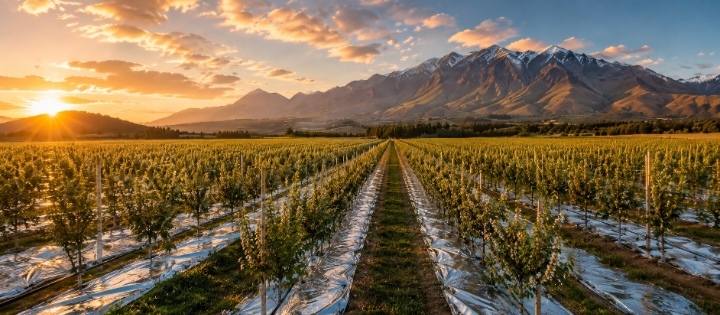
As orchard systems move toward higher planting densities and closer tree spacing, effective light management becomes increasingly important. Reflective ground cover redirects available sunlight from the orchard floor into lower and shaded canopy areas, supporting better light distribution in modern orchard systems.
WHY METALLISED PE?
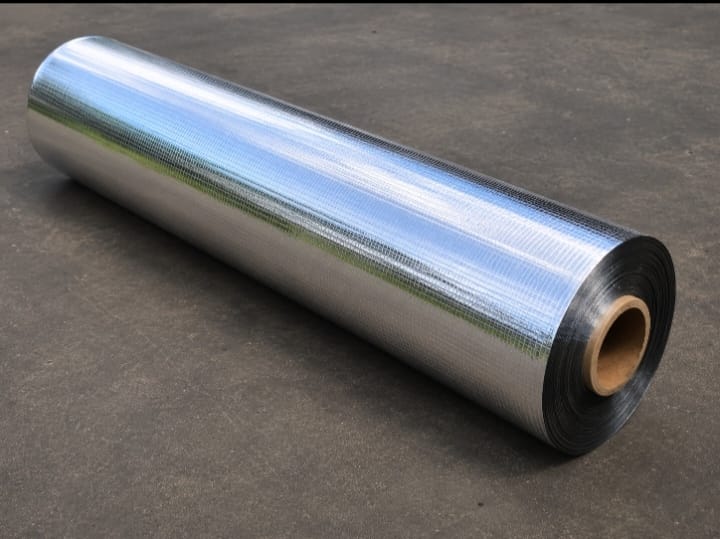
The material itself matters. Polyethylene (PE) provides the flexible base needed for a film that must be unrolled across long orchard rows, secured at ground level and later removed after use. The metallised surface gives the film its high reflective character, creating a lightweight material capable of redirecting available sunlight without requiring permanent orchard infrastructure. For commercial orchard use, the combination offers several practical characteristics: Lightweight for handling and deployment. Flexible enough to follow the orchard floor. Available in long rolls for commercial row installation. Highly reflective without the weight of rigid reflective materials. Suitable for seasonal deployment and removal. The result is a reflective material designed around the practical realities of orchard use.
Decades of International Research
Reflective orchard ground cover has been researched and used commercially across major fruit-producing regions including Chile, the United States, Spain, Italy, Australia and New Zealand.
Research across apples, pears, cherries and other fruit crops has examined its influence on canopy light distribution, fruit colour development, anthocyanin accumulation, maturity, soluble solids and harvest quality.
The principle is remarkably simple: sunlight reaching the orchard floor does not have to be lost.
A highly reflective surface redirects part of that light upward into areas of the canopy that would otherwise receive considerably less direct sunlight.
That simple change to the orchard light environment is the foundation of reflective ground-cover technology.
Frequently Asked Questions
Metallised PE is polyethylene film with a thin metallic reflective layer applied to its surface. This creates much higher reflectivity than ordinary white or light-coloured agricultural plastic while retaining the flexibility and low weight of PE film.
A micron (µm) is one-thousandth of a millimetre and is the standard measurement used for thin plastic films.
Thickness primarily affects the film’s physical strength, weight, handling and durability. It should not be confused with reflectivity — a thicker film is not automatically a more reflective film.
Not necessarily. Reflectivity is important, but commercial orchard performance also depends on material strength, surface quality, UV stability, installation and how well the film maintains its condition during use.
A laboratory reflectivity number should therefore be considered alongside the rest of the product specification.
Yes. Anything covering the reflective surface can reduce the amount of sunlight reaching it.
Normal outdoor exposure is expected, but heavy accumulations of soil, dust, leaves or other debris can interfere with reflection and should be minimised where practical.
The film is intended for outdoor agricultural conditions and normal exposure to moisture is expected.
After rain or irrigation water dries or drains away, the reflective surface continues to function. Installation should, however, avoid creating areas where water is unnecessarily trapped or drainage is obstructed.
Like other agricultural films, metallised PE is exposed to UV radiation, heat, moisture, wind and physical wear during use.
The rate of deterioration depends on the film specification and exposure conditions, which is why UV stabilisation and the intended service life are important parts of the product specification
Its primary function is to alter the light environment, not to act as a heating system.
Fruit temperature is influenced by multiple factors, including direct solar exposure, air temperature, wind, canopy position and orchard conditions. Reflective-ground-cover research therefore considers light and temperature as separate but interacting factors.
Sunburn is influenced by fruit surface temperature, solar exposure, cultivar, acclimation and weather conditions, rather than reflection alone.
Reflective ground cover should be used as part of the orchard’s existing canopy and sunburn-management strategy, particularly during periods of extreme heat.
Yes. Reflection is influenced by the position of the sun, row orientation, canopy architecture and the angle of the reflective surface.
A film that is folded, heavily wrinkled or poorly positioned will interact with incoming sunlight differently from a properly exposed surface.
Covered areas cannot reflect sunlight effectively because the light reaches the vegetation or debris instead of the metallised surface.
Keeping as much of the reflective area open and exposed as practical helps preserve the usable reflective surface.
Yes, but the terrain needs to be considered during installation.
Slopes, depressions and uneven surfaces can affect film positioning, securing, drainage and exposure to wind, so installation may need to be adapted to the individual block.
PE film naturally responds to temperature and may expand, soften or become more flexible as temperatures rise.
Agricultural film intended for orchard use should therefore be specified for outdoor exposure, with appropriate material construction and UV stabilisation for the intended period of use.
Seasonal film is specified for a shorter period of outdoor use, while enhanced UV stabilisation is designed to slow polymer degradation caused by prolonged exposure to sunlight.
UV stabilisation does not make a film indestructible; handling, weather exposure, installation and storage still influence its usable life.
Keep rolls dry, protected from direct sunlight and excessive heat, and away from sharp objects or chemicals that could damage the film.
Store them securely so that the rolls cannot become crushed, punctured or distorted before deployment.
The film should be carefully lifted, rolled and kept as clean as reasonably possible during removal.
Depending on its condition and specification, it can then be assessed for appropriate storage, reuse where applicable, or recycling/disposal through suitable plastic-waste channels
RECYCLING & MATERIAL RECOVERY At the end of its usable lifespan, AgriSun metallised PE reflective ground cover should be treated as a recoverable agricultural material rather than automatically becoming general waste. Polyethylene (PE) is a recyclable polymer, and South Africa has established recycling streams for PE film and agricultural plastics. Once the film has reached the end of its service life, it should be collected, rolled or bundled and kept as free as practical from soil, vegetation and other contamination. WHERE CAN IT GO? Metallised PE film can be directed to suitable plastics recyclers or agricultural-plastic recovery facilities for recycling.